Meta Andromeda: The AI Revolution That is Redefining Digital Advertising
Meta Andromeda is trending everywhere this month, but the algorithm change has quietly reshaped ad performance since December 2024. The real…

Meta Andromeda is trending everywhere this month, but the algorithm change has quietly reshaped ad performance since December 2024. The real question isn’t “what is it?” but “why are some brands scaling while others fall behind?”
Andromeda isn’t just another Meta update, it’s a complete rewiring of how ads get served. If you’re still running Meta ads like it’s 2023, you’re already getting left behind. The gap between winners and losers is widening faster than I’ve seen in my 15 years of digital marketing experience.
What’s fascinating? Andromeda was launched in December 2024, but take a look at this Google Trends data.
Why the sudden surge in October 2025? Because the performance gaps are becoming impossible to ignore. Early adopters are scaling. Everyone else is struggling. It’s evolution, not revolution. Meta is accelerating the shift from media buying hacks to real marketing quality.
What Andromeda Actually Is
Let me cut through the jargon and explain what’s happening.
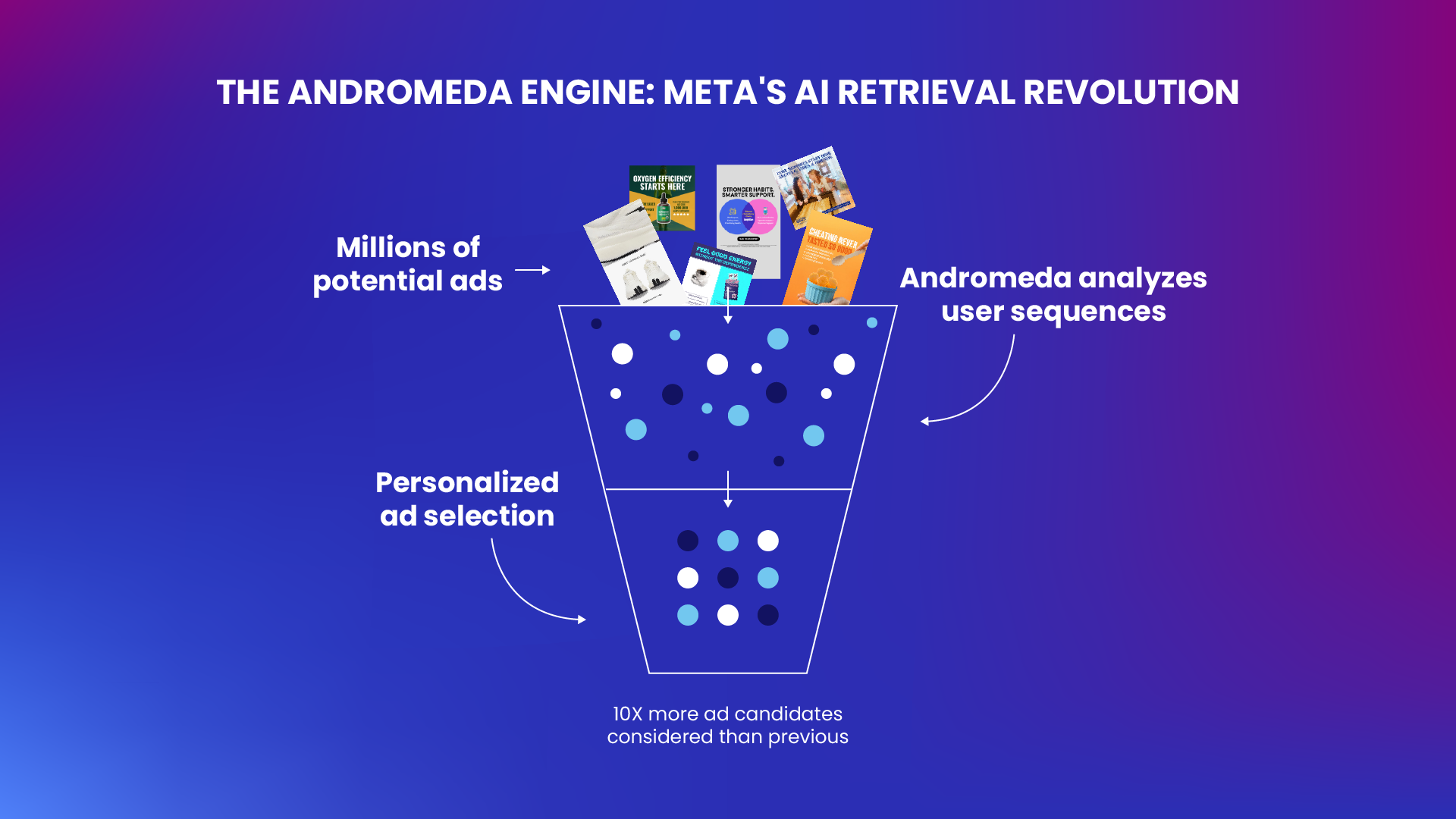
Andromeda is Meta’s next-generation ads retrieval engine, launched in December 2024, that selects which ads are shown to each person.
Think of it as a super-smart bouncer at the club door.
Before: This bouncer could only evaluate a limited number of people quickly.
Now: It can process many more options in the same split second.
Why does this matter? Because Meta’s older systems were hitting a wall. As Advantage+ automation and AI-generated creatives exploded the number of available ads, the bottleneck wasn’t in creating or optimizing ads, but in the Meta’s ability to consider enough options fast enough.
Andromeda solves this with a custom neural network running on specialized hardware (NVIDIA Superchips and Meta’s MTIA silicone). This design means it can evaluate far more creatives without slowing down the feed.
- In plain English: Meta can now show people ads they’re more likely to respond to by considering many more options than before.
Meta Engineering: Andromeda Announcement (Dec 2024)
Meta Engineering: Sequence Learning (Nov 2024)
The Strategic Shift: What Actually Changes
This isn’t just a technical upgrade; it fundamentally changes how Meta ads work in four key ways:
-
Creative diversity trumps targeting precision
The old Meta playbook was about precision targeting: finding the perfect audience segments and custom audiences. With Andromeda, Meta can identify who is most likely to respond to your creative, regardless of traditional targeting parameters.
What wins now is creative variety: more concepts, more formats, more messages, not more audience refinement.
-
Advantage+ just got a massive upgrade
Andromeda is the engine powering Meta’s Advantage+ automation. The AI now has far more options to test and learn from, making automation more effective than ever (in theory)
Brands still running manual campaigns will fall further behind as Advantage+, paired with Andromeda can now make smarter decisions.
-
Signals matter differently now
The signals that inform Andromeda’s decisions are changing. Traditional targeting relied on explicit interests and behaviors, but Andromeda’s networks can detect subtler patterns across user interactions over time.
This is why sequence learning matters, Meta is now looking at patterns in how users engage with content, not just what they engage with.
Diving deeper into sequence learning: Andromeda represents Meta’s shift from traditional models to sequential neural networks that process user behavior as time-series data. This setup fundamentally changes how the algorithm interprets signals.
The old model assigned static weights to individual actions: “This person liked X, so they might like Y.” Andromeda processes information as sequential data points that derive meaning from their relationship to each other: “This person engaged with X, then Y, then Z, in this specific order, with this specific timing pattern, which correlates with purchase behavior for people in similar cohorts.”
A user who watches 10 seconds of a video, then visits a profile, then comments has completely different intent than someone who performs those same actions in reverse order.
The implications are profound: your audience strategy must evolve beyond static interests. Andromeda doesn’t just care about who’s in your target, it cares about the relationship between engagements across Meta’s ecosystem, including behavior patterns you can’t see or directly influence.
The smartest brands have stopped obsessing over audience definition and started focusing on content diversity that can activate across multiple engagement sequence patterns simultaneously.
-
Measurement must evolve
With retrieval and ranking becoming more sophisticated, simple attribution models are even less reliable. Winners will be those who can measure true incremental value, not just last-click conversion metrics.
The probabilistic measurement shift: Andromeda accelerates Meta’s move from deterministic to probabilistic measurement models. Deterministic attribution (tracking a specific user’s path to purchase) is becoming increasingly unreliable in a post-iOS 14 (remember that), cookie-restricted world.
Meta’s internal models now use sophisticated probabilistic approaches, calculating the likelihood that an ad influenced a conversion rather than definitively claiming credit for it. This creates a massive disconnect between what Meta reports and what your business actually experiences.
These internal models already know which users would have converted anyway, which need a gentle nudge, and which require sustained persuasion. Your attribution system doesn’t.
The incrementality imperative: This gap between Meta’s reporting and business reality is widening further with Andromeda. In our audits across we consistently see gaps between platform ROAS and actual business growth.
True incrementality, measuring what happened because of your ads that wouldn’t have happened otherwise, is now the only measurement that matters. Meta’s sophisticated algorithms already optimize for this internally, but your reporting doesn’t reflect it.
Smart advertisers are implementing:
- Geo-split testing
- Conversion lift studies with proper holdout groups
- New customer acquisition costs as a primary KPI
- Multi-touch attribution models
- Blended and new customer contribution margin calculations
They’re also getting comfortable with ambiguity, accepting that perfect measurement is now impossible and focusing instead on directional insights and top-line business growth.
Breaking the attribution trap: Many brands fall into the trap of optimizing for what’s easiest to measure rather than what actually drives growth. Andromeda makes this trap even more dangerous by widening the gap between platform metrics and business reality.
The brands that scale in the Andromeda era won’t be those with perfect attribution models, but those who can tolerate measured risk and embrace media investment as a driver of overall business growth, not just direct response efficiency.
Winners vs Losers: The Dividing Line
The early data is clear: some brands are thriving with Andromeda while others are seeing performance tank. Here’s the dividing line:
Winners are embracing consolidation
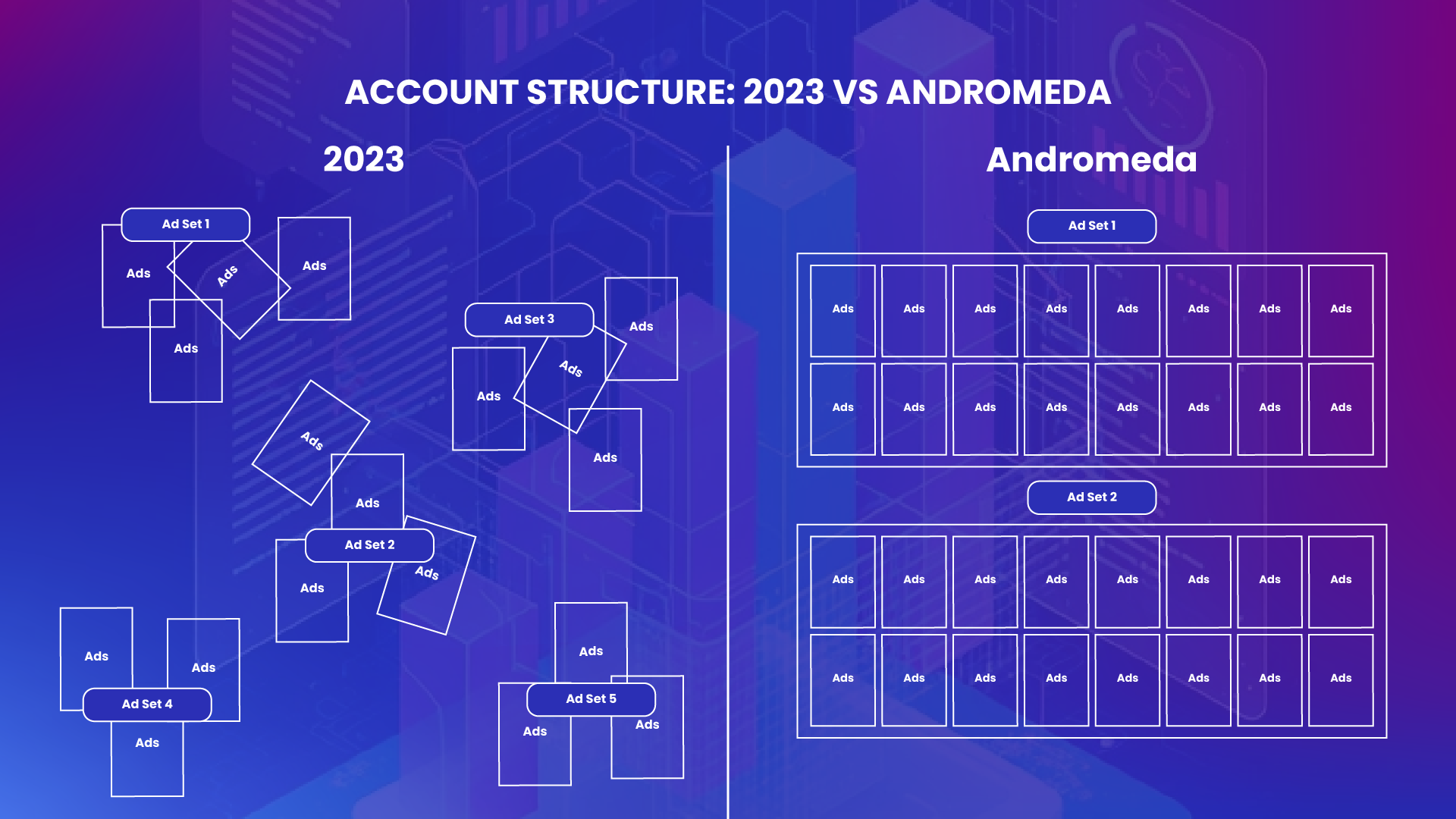
The brands seeing wins are consolidating their account structure: fewer ad sets with more ads in each. This gives Andromeda more data in concentrated places instead of fragmenting activity across many targeted ad sets.
Accounts with consolidated structures and 15 or more ads per ad set are consistently outperforming the traditional approach of multiple ad sets with fewer ads each.
Losers are stuck in the micro-variation trap
Brands still launching 10 nearly identical ads with minor text or image changes are getting crushed. Why? Because they’re not giving Andromeda enough creative diversity to find winning patterns.
When every ad looks the same, you’re not testing concepts, you’re testing insignificant details. Andromeda needs conceptual diversity to work its magic.
The organic advantage
Brands with robust organic marketing operations are winning big. Why? They already have a diverse content engine producing varied assets. These brands deploy different creative approaches without starting from scratch. Brands relying only on product renders are struggling to generate the diversity Andromeda needs.
Think about your own scrolling experience. Which would you respond to:
- Varied, engaging content that feels native
- The same sterile product shots over and over
Winners understand the new timeline
Patience is now a competitive advantage. Ads need more time to build momentum in the Andromeda era, sometimes two to three times longer than before. Brands killing ads after 3-5 days of mediocre performance are cutting off potential winners before they have a chance to scale.
The most successful campaigns we monitor let creative run longer, with spend shifting between ads in the same ad set over time, rather than one ad immediately dominating.
Our Approach: Working With, Not Against
Here’s exactly how we’re adapting our strategy to leverage Andromeda:
- Creative Breadth Over Depth
We’ve revamped our creative briefs. Instead of developing 10 variations of the same concept, we now produce fewer assets that take bigger swings between ideas.
This means:
- More distinct messaging angles in a single brief
- Greater variation in visual approach
- Mixing formats (static, video, carousel) within the same ad set
- Less emphasis on minor copy or design tweaks
When an asset shows promise, we don’t just duplicate it with small changes, we transform it into different formats. An image gaining traction becomes a motion graphic or video in the same ad set, allowing Andromeda to learn which format delivers best for which users.
The biggest client objection we face is the belief that more ads equals better testing. Many brands expect 30 or more ads from a single brief, all with minor variations. We now explain that 5-6 truly different concepts outperform 30 nearly identical ads in the Andromeda era.
- Structure Simplification
We’ve simplified our account structures:
- Fewer, broader ad sets
- More ads per ad set (aiming for 15+ at a minimum)
- Less segmentation by creative type
- Combining formats that we previously would have separated
This consolidation gives Andromeda more data in fewer places instead of fragmenting signals across many narrow ad sets.
Our most effective structures right now:
- Single CBO (Campaign Budget Optimization) campaign with one scaling ad set and one testing ad set, allowing spend to move naturally between the two
- Single ad set campaigns combining both scaling and testing ads
- Campaigns organized by persona or audience segment, with all creative variations within each
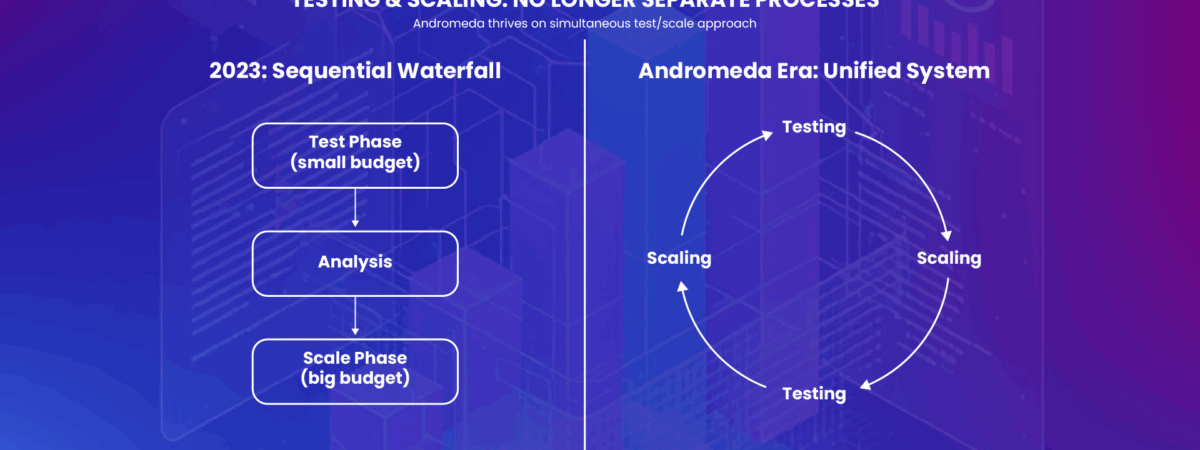
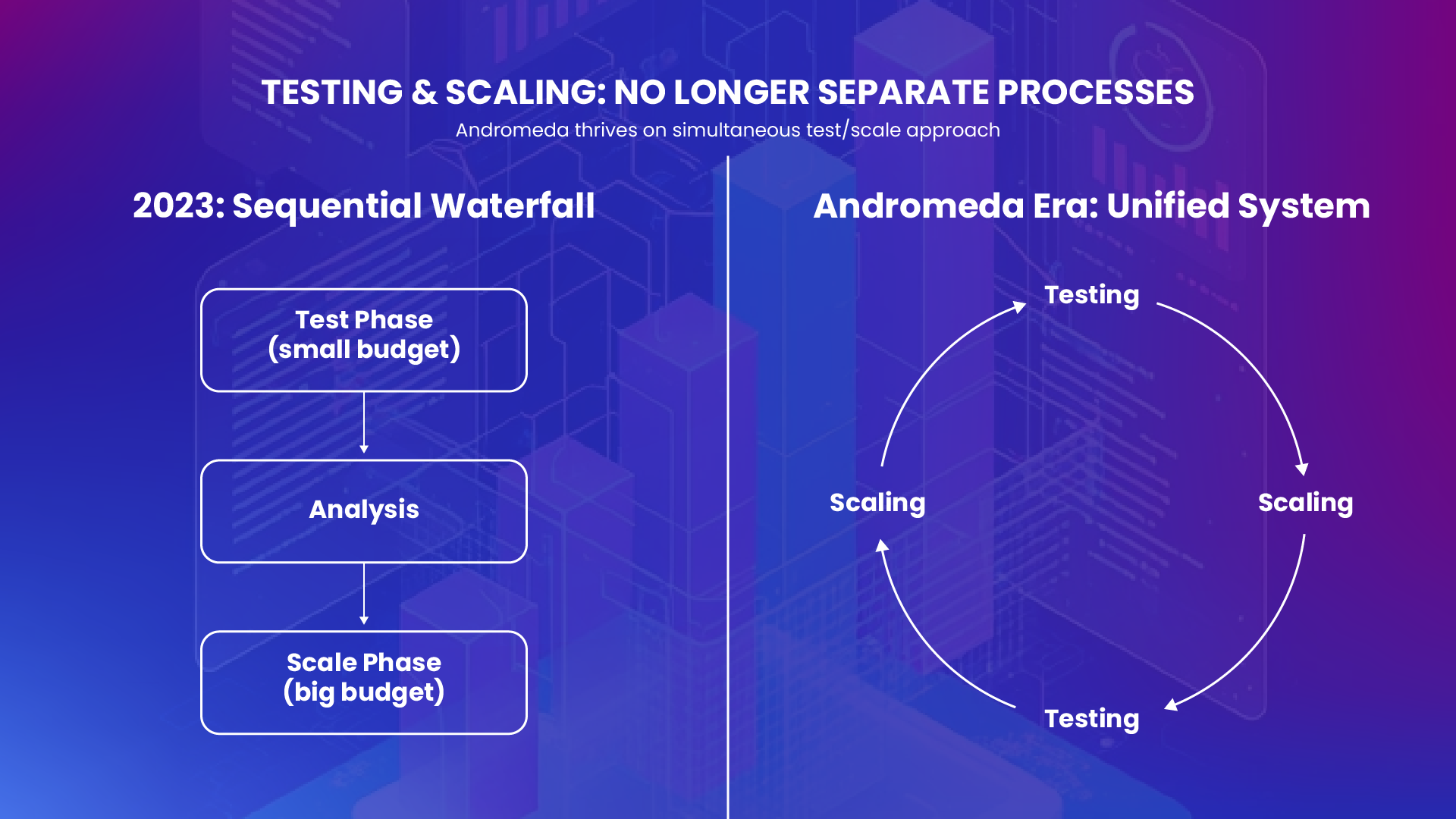
- Testing & Scaling Are Now The Same Thing
The line between testing and scaling has blurred. Instead of the traditional “test small, then scale winners” approach, we’re:
- Launching more varied concepts directly into scaling campaigns
- Allowing longer learning periods before making decisions
- Focusing on creative iteration within live ad sets rather than duplicating winners
This approach plays to Andromeda’s strengths, feeding it more diverse options and giving it enough time and data to make better decisions.
Action Plan: Next Steps for Brands
If you’re looking to capitalize on Andromeda rather than get left behind, here’s your roadmap:
Immediate Actions (Next 7 Days)
- Audit your current account structure, identify opportunities for consolidation
- Review creative diversity across active ad sets. Are you giving Andromeda enough variety to work with?
- Extend thresholds for creative testing. Give ads at least 7-10 days before turning them off.
The good news is you don’t need to wait months to see an impact. We are seeing meaningful results within a week of account structure changes and within weeks of shifting creative brief approaches.
Measuring Success
Look beyond the standard metrics to evaluate your Andromeda-optimized campaigns:
- Creative engagement distribution (are multiple ads receiving meaningful engagement?)
- Performance stability over time (are ads building momentum rather than burning out?)
- Format effectiveness by audience segment (which formats work for which users?)
- True incremental value through proper lift testing
The Future: Meta’s Increasing Control
Where is all this heading? Meta’s control over advertising tactics and the user experience has increased dramatically in recent years, and Andromeda accelerates this trend.
We’re moving from a media buying tactical game to a marketing game.
Creative storytelling is now the most significant input we control. Content, narrative, and creative execution are now more important than ever.
This is good news for real marketers. The era of growth hacks is fading. Brands that focus on creating engaging, diverse content with a strong message and offer will win.
TL;DR: Why Andromeda Changes Everything
Andromeda isn’t just an update, it’s a fundamental shift:
- Creative diversity > audience precision
- Account consolidation > fragmentation
- Patience > quick kills
- Format variety > single-format testing
- Testing = scaling now
- Results visible within weeks
- Organic content engines = massive advantage
Brands that adapt fastest will gain a huge advantage. Those stuck in the old playbook will see performance decline as Andromeda evolves.
The future of Meta advertising isn’t about finding the perfect target audience. It is about creating enough creative diversity for Meta’s AI to find the right audience for each concept. The time to adapt is now.
Related Articles
- PPC
What Great Paid Search Performance Hides, and Why D2C Marketing Leaders Need to Know
The “best-performing” paid search accounts don’t always fuel the most growth. As someone who’s audited and managed paid search accounts across…
- General
5 Reasons DTC Brands Plateau
They never run the numbers Every brand knows their ROAS, CPC, CTR, etc. How many brands can tell you their contribution…
- PPC
Your Google Ads Metrics Look Great, So Why Aren’t You Growing?
At a glance, everything looks great. Your Google Ads account is hitting ROAS targets. Spend is stable and efficient. Branded search…
How can we help you grow?